









12 on the lineup
Deliberate Descent Safeguards Injured Area
I have found that the most effective way to adapt a training routine around an injury is to shift the focus from absolute intensity to mechanical efficiency through a technique called blood flow restriction. When a joint or connective tissue is compromised, you can no longer rely on heavy external loads to stimulate muscle growth or maintain strength without risking further damage. By using specialized bands to partially restrict venous return, I can achieve a high level of metabolic stress using only twenty to thirty percent of my usual weight. This allows the nervous system and the muscles to feel like they are working at a maximum capacity while the actual mechanical stress on the injured area remains safely within a rehabilitative range.
The key modification that makes this possible is the intentional slowing of the tempo, particularly during the eccentric phase of each movement. By removing all momentum and focusing on a slow, controlled descent, I can eliminate the shearing forces that typically aggravate an injury. This change forces me to focus on the mind-muscle connection and stability rather than just moving a weight from point A to point B. It turns the training session into a form of active recovery that promotes blood flow to the area while preventing the muscle atrophy that often follows an injury. This approach taught me that progress is not always about adding more weight, it is about finding the most sophisticated way to challenge the body within its current constraints.
Prime Glutes With Sequential Activation
When a runner presents with chronic knee pain and poor squat mechanics, I adapt their strength work rather than stopping it. The key modification I use is sequential activation, teaching targeted glute engagement and short activation drills before any loaded squat or lunge. We follow that with a slow controlled tempo and slight foot position adjustments so the hips drive the movement and the knees track safely over the toes, allowing continued progress while reducing knee stress. Pain and load are monitored closely and resistance is increased gradually to protect recovery while restoring strength.
Adopt Palm-Up Tamper Technique
I developed tendinitis in my right wrist from tamping espresso shots thousands of times over a couple of years. Anyone who's worked a busy coffee bar knows the repetition, grab the portafilter, lock it in, tamp with pressure, twist, pull the shot, repeat. After about eighteen months of that without any structured variation, my wrist started aching constantly, and some mornings I couldn't grip the tamper without sharp pain. I kept pushing through it, which was dumb, and it only got worse until I couldn't ignore it anymore.
The modification that saved me was switching my entire tamping technique. I'd always used a palm-down, straight-arm approach where all the force came from my wrist. A physical therapist I saw suggested a palm-up, elbow-down position that transfers the load to your forearm and shoulder instead. It felt completely wrong at first, like learning to write with my left hand. My shots were inconsistent for about two weeks. But once the muscle memory adjusted, I was actually getting more even extraction because the force distribution was better. The key wasn't stopping work or avoiding the movement entirely, it was changing the mechanics so the injured tissue wasn't bearing the load.
I also built in a habit of doing grip-strengthening exercises with resistance bands during slow periods on shift. That's probably the part that's made the biggest long-term difference. Now when we onboard new baristas at equipoisecoffee.com, we actually teach the modified tamping technique from day one instead of waiting for someone to get hurt. It doesn't sound like a big deal, but for a coffee business where your body is your primary tool, these technique adjustments are everything.
Swap Impact for Swim and Cycle
I've had to modify my own training approach after developing runner's knee last year. Working at The Family Doctor Primary Care, I'm surrounded by healthcare professionals who helped me understand that pushing through pain isn't the answer.
The key modification was switching from high-impact running to swimming and cycling while my knee healed. I maintained my cardiovascular fitness without stressing the inflamed tissue. Our physicians at familydoctor.md often tell patients that you don't have to stop exercising when injured; you just need to exercise differently.
What made this work was getting a proper diagnosis first. Once our medical team identified it as patellofemoral pain syndrome, they gave me specific guidelines on what movements to avoid and what would help me recover.
I incorporated resistance band exercises to strengthen the muscles around my knee without loading the joint itself. This was a game-changer because I was actually addressing the root cause while staying active.
The biggest lesson I've learned from both my personal experience and working alongside our providers at The Family Doctor Primary Care is that modified training isn't lesser training. I maintained my fitness levels and came back stronger because I respected the healing process.
For anyone dealing with an injury, get evaluated by a medical professional first. We see patients at familydoctor.md who've made their injuries worse by doing the wrong modifications. The right adaptation depends entirely on what's actually injured and how severe it is.
Patience played a huge role too. I wanted to rush back to running, but gradually reintroducing impact over weeks, not days, prevented re-injury. Progress isn't always about doing more. Sometimes it's about doing what's appropriate for where your body currently is.
Position Equipment to Minimize Relocation
We deal with injuries on our survey crews more often than I'd like to admit. South Texas terrain can be unforgiving, and our crews navigate everything from thick brush to steep creek banks while carrying equipment that weighs thirty pounds or more. When someone gets hurt, we've learned that the worst thing we can do is shut them down completely.
A couple of years ago, one of our survey technicians strained his ACL while hiking out to a remote boundary corner. Instead of pulling him from all field work and confining him to office data processing, we worked with his physical therapist to identify tasks he could still perform safely. He ended up running our robotic total station for the next six weeks, which meant he stayed on the job site but didn't have to do the physical navigation that aggravated his knee.
The key modification that made this work was setting up the equipment at the start of each day and positioning it so he could survey the necessary points without having to relocate frequently. It required more planning upfront and sometimes meant we needed an additional crew member to handle the rod work, but it kept our injured technician engaged and productive during recovery. He told me later that being able to contribute rather than sitting at a desk doing paperwork made a huge difference in his mental health during rehab.
Since then, we've developed what we call our "modified duty matrix." It maps common injuries to specific surveying tasks that can be performed safely. A shoulder injury might mean running GPS equipment instead of carrying a total station. A back issue might mean doing office-based calculations and research while the crew handles the field work. The point is that recovery and progress don't have to be mutually exclusive, and the specific modification that makes it possible is usually just a matter of thinking creatively about how to use your team's skills in different combinations.
Choose Trap Bar and Unilateral Patterns
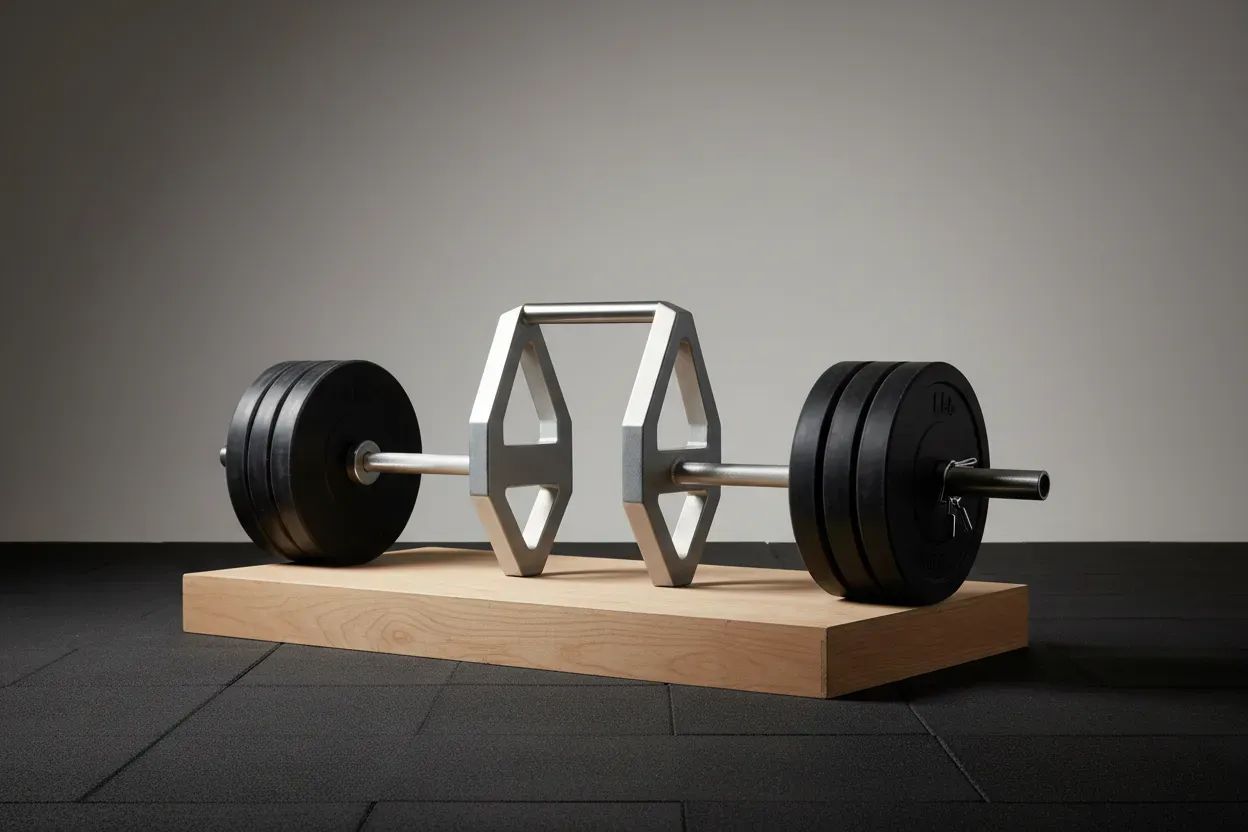
One of the most effective adaptations I've used was during a lower back strain while deadlifting. Instead of forcing the movement or stopping training completely, I shifted to a pain-free range and alternative patterns that still trained the same muscles without aggravating the injury.
The key modification was swapping heavy conventional deadlifts for trap bar deadlifts, Romanian deadlifts with lighter loads, and single-leg work like split squats. This reduced spinal stress while still loading the posterior chain. I also adjusted intensity using RPE caps (around 6-7) so I could train consistently without pushing into pain.
Another important piece was focusing on tempo and control, slower eccentrics and better positioning, so I could maintain stimulus without heavy weight. That allowed me to keep strength and even improve movement quality during recovery.
As a NASM Certified Nutrition Coach (CNC) and ISSA Nutritionist, I've learned that the goal during injury isn't to maintain your exact routine, it's to maintain momentum safely. When you respect pain signals, adjust load, and keep training what is available, you often come back stronger and more resilient.
Run Demos With Voice and Modules
Last year I developed pretty severe tendinitis in my right wrist from the endless clicking and typing that comes with running demo sessions for Free QR Code AI. I couldn't exactly stop working, and we had a major product launch coming up with several partner training sessions scheduled. The pain was bad enough that my doctor told me to significantly cut back on mouse usage and typing.
The key modification that saved me was switching to voice-controlled navigation and dictation software for all my live demos. I also restructured our training format completely. Instead of me clicking through the platform in real-time, I pre-recorded the core walkthroughs of our QR code generator and had them embedded in interactive modules. During live sessions, I'd use voice commands to switch between segments while talking participants through the process. They'd follow along on their own screens while I guided them verbally.
What surprised me was that this adaptation actually improved our training outcomes. Participants retained more information because they weren't just watching me click around. They were doing it themselves while I provided verbal coaching. Our completion rates went up about twenty percent compared to the traditional screencast format.
I also started using our own QR codes more creatively during this period. Instead of typing out links during Q&A sessions, I'd generate codes on the fly and display them so participants could scan directly to resources. It became this great real-world demonstration of our product's value while saving my wrist.
The enforced constraint made me a better trainer. I learned that doing less live demonstration and giving participants more hands-on practice time actually accelerated their learning. Even after my wrist healed, I kept most of these modifications because they simply worked better than my original approach. Sometimes your biggest limitations push you toward your best new ideas.
Progress With Micro Increments
I adapted my training by using micro loading to protect an injured joint while still making progress. I increased weight by the smallest possible increments, sometimes only one pound, and kept overall volume the same. I maintained smooth, controlled reps and scheduled increases roughly every two weeks. This small, gradual progression respects that connective tissue adapts slower than muscle and helped prevent flare-ups while allowing steady gains.
Prioritize Posture and Daily Mobility

I adapted my training for an injury by shifting the focus from heavy, high-impact sessions to short, consistent mobility and posture work paired with daily low-impact movement like walking or yoga. The key modification was prioritizing posture and mobility education over intensity and tracking progress through regular, measurable checkpoints. That change preserved recovery by reducing stress on the injured area while keeping behavior and consistency intact. We apply the same tactic in our corporate programs when musculoskeletal claims rise, using posture education, ergonomic assessment, and movement initiatives to support return to function while monitoring outcomes.
Replace Bilateral Work With Single Leg
I'm Runbo Li, Co-founder & CEO at Magic Hour.
The biggest mistake people make when they get injured is thinking in binary: train or don't train. The real unlock is what I call "constraint-driven adaptation," where the limitation itself forces you to find a better path than the one you were on.
About a year ago I tweaked my lower back badly. Deadlifts, squats, anything with spinal loading was off the table. My first instinct was to rest completely, but after a week of doing nothing I felt worse, not better. Stiff, sluggish, mentally foggy. So I flipped the question. Instead of asking "what can't I do," I asked "what can I load maximally without touching my spine?"
The answer was single-leg work and carries. I went deep on Bulgarian split squats, single-leg RDLs with light dumbbells, and heavy farmer carries. The key modification was removing bilateral loading entirely. No barbell on my back, no barbell in front of me pulling my spine into flexion. Everything unilateral, everything forcing my stabilizers to work overtime.
Here's what surprised me. After eight weeks, when I finally returned to squatting, my numbers came back faster than expected. My hip stability was dramatically better. My core was stronger because those single-leg movements had been demanding trunk control the entire time without compressing my spine. I actually came back better than before the injury.
The principle that made it work was simple: find the highest-intensity stimulus you can apply to the tissues that aren't injured, and let the injured area heal through movement, not immobility. Total rest is almost never the answer unless something is structurally torn. Controlled movement with intelligent load management accelerates recovery because blood flow and mechanical signaling matter.
The real takeaway is that constraints are not the enemy of progress. They're the editor. An injury forces you to strip away the ego lifts and focus on what actually builds a resilient body. Some of my best training blocks have come from periods where I couldn't do the thing I wanted to do, so I had to do the thing I needed to do.
Adjust Nutrition to Match Reduced Output
The most useful thing we observed building a food and nutrition app is that users who log consistently through an injury almost always do it wrong in one direction: they keep the same calorie target while their output drops, then wonder why recovery stalls. The adaptation that actually works is treating the injured period as a deliberate recomposition window rather than a maintenance pause. When I tore a shoulder muscle two years ago, I kept lower body volume high, dropped total calories modestly to reflect reduced output, and increased protein closer to 2.2 grams per kilogram to protect muscle while tissue healed. The key modification was not the exercise swap. It was treating nutrition as the training variable I could still control fully. Most people change what they lift and leave the plate identical. That mismatch is where progress and recovery both get lost at the same time.
Use Floor Presses for Shoulder Relief

A couple years ago I tore my right rotator cuff, and it completely derailed my bench press progression. I'd been hitting PRs consistently at the time, so stepping back felt brutal. Instead of pushing through pain and making things worse, I switched to floor presses and paused repetitions with a significantly lighter load, focusing purely on time under tension and controlled eccentrics.
The real game-changer was dropping the weight to about fifty percent of my working sets and performing every rep with a four-second negative. This kept tension on the chest and triceps without grinding the injured shoulder through the bottom portion of the lift, which is exactly where the impingement was worst. I also swapped barbell work for dumbbells so my shoulder could find its natural groove instead of forcing a fixed grip path.
Within six weeks my shoulder felt stable enough to gradually reintroduce full range of motion. The surprising part was that when I returned to my pre-injury bench numbers, my form was noticeably tighter because those slow eccentrics had built genuine strength and control throughout the entire movement. I've actually kept floor presses in my rotation permanently now.
Running Scale By SEO (scalebyseo.com) keeps my schedule packed with client campaigns and strategy calls, so I can't afford long layoffs from the gym. The lesson translated to my work too. When a core algorithm update disrupts a client's organic traffic, you don't panic and overhaul the whole strategy. You isolate what broke, adapt your approach, and rebuild from a position of control. That's what modifying my training taught me. Slow down the variable you can control, protect what's still recovering, and trust that the foundation you're reinforcing will hold up when full intensity comes back.